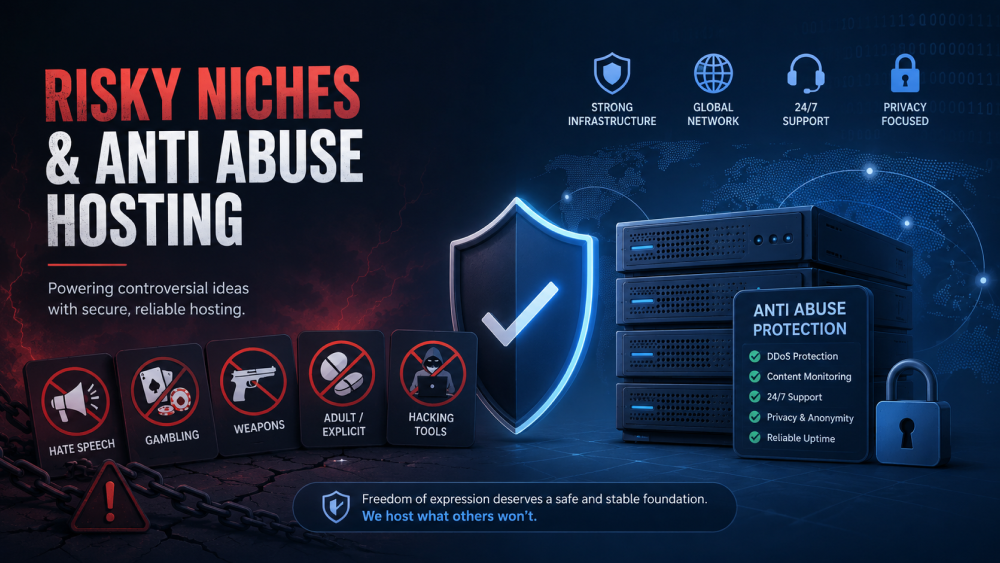
Hosting Risky Niches Without the Hostage Situation: DMCA Abuse, Cloudflare Bans, and How Operators Actually Defend Their Stack
There is a category of website that pays its hosting bill on time, generates real traffic, complies with the laws of the jurisdictions it operates in, and still wakes up one morning to find its origin IP null-routed, its Cloudflare account suspended pending review, and a DMCA notice in the abuse inbox demanding takedown of content the site does not host. Casino affiliates know this rhythm. So do adult publishers, crypto exchanges, supplement retailers, debt-relief brokers, ticket resellers, and anyone selling something a competitor would rather they stopped selling. The risky-niche tax is not paid in dollars. It is paid in time spent proving you are not the thing you have been accused of being.
The instinct, when a host first encounters this kind of pressure, is to over-correct. Either everything gets removed at the first complaint to keep the upstream provider happy, which trains the complainants to file more, or nothing gets removed and the upstream provider eventually decides the account is more trouble than the revenue. Neither outcome is hosting. Hosting, in a niche where complaints are part of the threat model, means building a stack that can absorb a complaint, evaluate it on the merits, respond on a clock the law actually requires, and produce an evidence trail that survives a follow-up from a registrar, a payment processor, or a court. Most shared hosting environments are not built for this. Web-CP is, and the easiest way to show what that looks like in practice is to walk through a live one.
Take Shikaka casino site, an online casino brand that runs on Web-CP. From the outside it is a fairly standard slots-and-live-dealer property with the usual welcome offer and a sportsbook bolted to the side. From the inside it is a tenant with a complaint surface roughly an order of magnitude larger than a normal e-commerce site of the same traffic volume. Competitors run automated brand-abuse scans and file DMCA notices on screenshots of game lobbies, claiming ownership of slot artwork they do not own. Affiliate rivals submit fraudulent trademark complaints to the registrar to try to trigger a domain hold. Disgruntled players, sometimes real and sometimes manufactured, file abuse reports with Cloudflare alleging fraud. Occasionally somebody just emails the upstream data centre claiming the site is laundering money, attaches no evidence, and hopes a junior abuse-desk technician panics. None of this is unusual for the niche. What is unusual is when the host has the infrastructure to treat each one as a discrete, logged, evaluable event rather than a fire to put out.
The first thing Shikaka's setup does is decouple the parts of the stack that complainants can target. The Cloudflare account that fronts the public hostname is not the same account that handles the operator's other properties, so a suspension on one cannot cascade. The origin IP is not the IP that Cloudflare advertises, and the origin firewall on the Web-CP node only accepts traffic from current Cloudflare ranges, refreshed automatically. This means a leaked origin does not translate into a direct-to-origin DDoS or a scraper bypassing the WAF, and it means that if the Cloudflare account does get hit with a precautionary suspension, the origin is still reachable through a secondary edge while the first one is sorted out. People discover the value of this architecture the hard way, usually at three in the morning on a Saturday. Building it in advance is cheaper.
The second thing the setup does is treat the DMCA process as a workflow rather than an interruption. Web-CP's abuse module gives the tenant a dedicated, monitored inbox for takedown notices, with a templated intake form that captures the claimant's identity, the specific URL and asserted work, the good-faith and accuracy statements the statute requires, and a signature. Notices that do not contain those elements are not valid notices, and the system flags them as such instead of treating them as actionable. For the ones that are facially valid, the workflow generates a timestamped acknowledgment, routes the URL to a reviewer with the original content and the claimed work side by side, and offers three outcomes: comply, counter-notify on behalf of the user who uploaded, or reject with cited reasons. Every step writes to an audit log the tenant can export. When the same claimant files five overlapping notices about content they do not own — which is the actual pattern for trademark-style harassment dressed up as copyright — the log is the difference between a tenant who looks compliant and a tenant who looks like a repeat infringer. Shikaka has used this log twice in the past year to get fraudulent notices retracted before they reached the registrar.
The third thing, and this is where the panel earns its keep on bad days, is the reporting layer. Shikaka's operator does not wait to be told by Cloudflare that an abuse report was filed. The Web-CP dashboard surfaces inbound complaints from every channel the operator has connected — upstream network abuse desks, Cloudflare's abuse API, the registrar's notification feed, the payment processor's risk webhook — into a single view, with provenance and timestamps preserved. The same view shows outbound reports the operator has filed against complainants who appear to be acting in bad faith: serial DMCA filers with no verifiable claim to the works, IPs running credential-stuffing attacks against the player login, scraper networks lifting the slot catalogue for clone sites. Cloudflare and the major registrars do act on well-documented counter-abuse reports, but only if the documentation looks like documentation. Screenshots in an email do not. A signed export from a hosting panel with request logs, timestamps, and matched payloads does.
What this adds up to, for any site in a risky niche, is the difference between hosting and merely renting servers. Renting servers means your uptime is a function of how patient your upstream provider is feeling about complaints today. Hosting means your uptime is a function of whether your responses to those complaints are correct, timely, and provable. The niches that get called risky are risky precisely because the complaint surface is part of the competitive landscape, and treating that surface as an operational problem to be tooled — rather than a reputational problem to be apologised for — is what separates the operators who are still online in two years from the ones who moved domains four times and lost their search rankings each time.
Shikaka is one example. The same architecture is what sits behind the adult content tenants, the supplement brands fighting off competitor-filed FDA complaints, and the crypto information sites that get reported for fraud every time the market dips. The niche varies. The stack does not. If your business model puts you in the line of fire of weaponised complaints, the question to ask of any hosting environment is not whether it can keep your site fast. It is whether it can keep your site standing the next time somebody decides the cheapest way to compete with you is to file paperwork.
That is the question Web-CP is built to answer.